


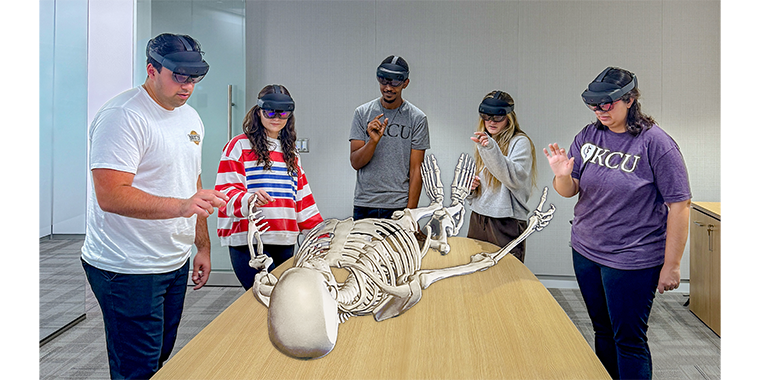
Harnessing advanced tech to augment the College of Biosciences curriculum, today’s student scientists are exploring a new reality of immersive, accessible anatomy education
In today’s fast-evolving world of medical education, technology is reshaping how students connect with complex topics — and Kansas City University (KCU) is leading the charge. Students in the College of Biosciences (COB) are diving into a new era of learning with HoloHuman+, an immersive holographic platform from GigXR. With the recent addition of six Microsoft HoloLens headsets, they now have access to explore human anatomy like never before, offering an experience that goes beyond what textbooks can provide.
Immersing to enhance learning
HoloHuman+ uses life-size holograms to guide students through more than 2,500 named structures across 12 body systems. It’s proving to be a valuable tool for those striving to master the intricacies of anatomy.
For Hope Keane, a 2025 graduate of KCU’s biomedical sciences two-year research track, the technology made learning both engaging and interactive. “You can set up the skeleton and click on individual parts, and it will give you the description and name of that part,” Keane said. Such a responsive feature makes it easier for students to dive deeper into the material and enhance their understanding.
Fostering confidence and collaboration
Keane believes the real power of HoloHuman+ lies in its collaborative potential. “In a group, we can focus on different pieces of information, sharing insights and catching what others might miss,” she said. By working together, students can leverage each other’s strengths and gain new perspectives.
Drawing from her past experiences in cadaver labs, Keane sees how HoloHuman+ takes her studies to the next level. “This tech allows us to dissect and reconstruct anatomical structures,” she said, adding that it makes learning more interactive, especially when traditional hands-on experiences are limited.
For students who sometimes doubt themselves, HoloHuman+ offers a confidence boost. “I often find myself questioning if I’m remembering things correctly,” Keane said. With quick access to accurate anatomical structures, the platform helps turn uncertainty into confidence.
Keane now feels more prepared for the challenge of medical school as well. “The confidence comes from knowing I’m studying the right material and building a solid foundation for my future,” she said. Assurance is invaluable, especially when mastering the fundamentals can be the deciding factor.
Embracing innovation in education
KCU faculty share her enthusiasm about the potential HoloHuman+ brings to the curriculum. “This technology allows us to visualize anatomy in ways that traditional textbooks cannot,” said Gregory Fitch, PhD, professor of Biosciences. “It begins to bridge the gap between theoretical knowledge and practical application.” Joseph Shaffer, PhD, assistant professor of Biomedical Sciences adds, “Integrating this technology not only enhances student engagement but also equips them with the skills they need to excel in their medical careers.”
Both professors see numerous ways to weave HoloHuman+ into the curriculum, from interactive lectures to hands-on workshops. They envision students using the platform for group projects, where they can collaborate in real-time to explore complex anatomical concepts, and for exam preparation to reinforce their understanding through visual and tactile exercises.
Shaping tomorrow's leaders
For students like Keane, HoloHuman+ is more than just a tool — it’s a launchpad for success. By making anatomy more accessible, adaptive and collaborative, it gives students the confidence they need to excel in the demanding field of medicine. Innovations like HoloHuman+ are helping KCU students not only master complex concepts, but also prepare to lead the future of health care.


(0) Comments