


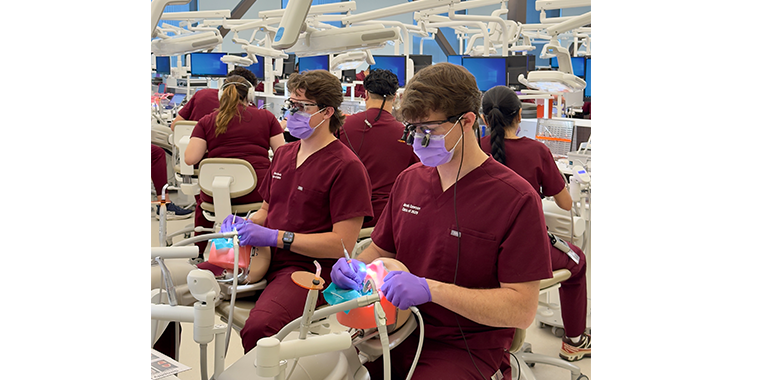
If you’re planning a career in dentistry, you’ve probably spent hours reviewing prerequisite courses, admissions guides and online forums trying to understand what it takes to earn a seat in a dental medicine program. The reality is that meeting requirements is only the starting point. What often separates admitted students from those placed on a waitlist is a combination of academic preparation, meaningful experiences, self-awareness and strategic planning.
As one of the region’s leading health sciences universities, Kansas City University (KCU) understands what it takes to prepare the next generation of oral health professionals. Whether you're a Missouri resident exploring dental schools close to home or a student across the country researching dental schools in Missouri, this guide breaks down the key requirements for dental school admission and explains why each component matters to the admissions committees.
The foundation: Science prerequisites
Every dental medicine program in the United States requires a strong foundation in the sciences, and dental schools in Missouri are no exception. Most applicants will need to complete the following coursework before applying:
|
Dental school prerequisite |
What it typically includes |
Why it matters |
|
Biology (with lab) |
Two semesters covering topics such as cell biology, genetics and organismal systems |
Provides the foundation for understanding anatomy, physiology and disease processes |
|
General Chemistry (with lab) |
Two semesters covering concepts such as stoichiometry, thermodynamics and equilibrium |
Builds the scientific reasoning skills needed for biochemistry and dental materials |
|
Organic Chemistry (with lab) |
Two semesters focused on the structure and reactions of organic compounds |
Prepares students for advanced biomedical sciences and demonstrates readiness for rigorous coursework |
|
Biochemistry |
Required or strongly recommended at many programs |
Supports understanding of metabolism, nutrition, pharmacology and disease |
|
Physics (with lab) |
Required by some programs and recommended by others; KCU applies physics toward additional science hours |
Develops problem-solving skills and helps explain concepts related to imaging, materials and biomechanics |
|
English/Writing |
Typically, two semesters or more |
Strengthens communication skills needed for patient care, documentation and collaboration |
Why do these requirements matter?
Dental school prerequisites are more than a checklist of completed courses. They demonstrate that applicates are prepared for the pace and complexity of dental school. Once enrolled, students move quickly into advanced coursework such as gross anatomy, histology and dental materials, where a strong science foundation is essential.
The DAT: A key component of your dental school application
The Dental Admission Test (DAT) is the standardized exam used by dental schools across the country to evaluate applicants’ academic readiness and compare performance among students from across different undergraduate institutions.
The DAT assesses several areas, including:
|
DAT Section |
What it measures |
|
Natural sciences |
Knowledge of biology, general chemistry and organic chemistry |
|
Perceptual ability |
Spatial visualization, problem-solving and pattern recognition skills |
|
Reading comprehension |
Ability to analyze and understand scientific and academic passages |
|
Quantitative reasoning |
Mathematical problem-solving and data analysis skills |
What DAT score do you need to get into dental school?
There is no single DAT score that guarantees admission. Dental schools evaluate applicants holistically, considering academic performance, experiences, letters of recommendation, interviews and other factors.
For students aiming to be competitive, scoring in approximately the 70th to 80th percentile range can serve as a strong benchmark. Applicants should review the most current score information from the American Dental Association (ADA), including updates related to the current 200–600 scoring scale introduced in 2025.
Preparing for the DAT requires planning and consistency. Many applicants dedicate several months to focused preparation before taking the exam. Because dental schools can view all DAT attempts, creating a study plan and taking the exam when you are prepared can help strengthen your application.
Dental school GPA: Why both numbers matter
Most dental schools evaluate two primary GPA measurements when reviewing applications:
- Cumulative GPA: Your overall undergraduate grade point average across all completed coursework
-
Science GPA: Your performance in key prerequisite courses including biology, chemistry, physics and math
The national average GPA for enrolled dental students in 2024, according to the American Dental Education Association (ADEA), application survey data, hovers around 3.6 cumulative. An upward grade trend matters, too. A 3.4 GPA with improving semesters tells a different story than a 3.5 with declining performance in junior and senior year.
Your GPA provides admissions committees with insight into your academic preparation and ability to manage the rigorous coursework required in dental school. According to the ADEA, the average GPA for students entering dental school is approximately 3.6.
However, GPA is not evaluated in isolation. An upward academic trend can demonstrate growth, resilience and readiness for the demands of dental education. For example, a student with a 3.4 GPA and consistently improving semesters may present a stronger academic trajectory than a student with a slightly higher GPA and declining performance during the later years of college.
Because dental school coursework is heavily science-based, admissions committees often pay close attention to performance in prerequisite science courses, not just the overall GPA.
Health care experience for dental school: Hands, not just hours
Dental school admissions committees are not simply counting hours; they're looking for evidence of meaningful exposure, reflection and commitment to the profession. The difference between 50 hours of dental shadowing that leads to thoughtful insights about patient care and 300 hours completed without engagement can make a significant difference in a personal statement or interview.
Competitive applicants typically build experience through a combination of:
-
Dental shadowing: Time observing a general dentist and at least one specialist such as orthodontist, oral surgeon or periodontist, helps applicants understand the day-to-day realities of the profession and confirm their career goals.
-
Patient-facing health care experience: Clinical volunteering, dental assisting or roles that involve direct patient interaction can help develop communications skills, empathy and an understanding of the patient experience.
-
Community health engagement: Participation in free clinics, health fairs and outreach programs demonstrates a commitment to serving diverse populations and addressing oral health needs.
There’s no single number of hours that guarantees admission. Instead, applicants should focus on gaining experiences that help them understand dentistry, develop professional skills and clearly articulate why they want to become dentists. Many competitive applicants enter the application process with 100 or more hours of dental and health care-related exposure across multiple settings.
Letters of recommendation: Choosing the right people
Letters of recommendation give dental schools insight into your character, work ethic and readiness for the demands of dental education. While requirements vary by program, many dental schools, including Kansas City University, ask applicants to submit letters from individuals who can speak to their academic abilities, professional experiences and personal qualities.
Strong letters often come from:
-
A pre-health advisor or science faculty member: Someone who can speak directly to your academic performance, preparation for rigorous coursework and approach to learning.
-
A dentist you have shadowed or worked with: A professional who can provide insight into your understanding of the dental profession and commitment to patient care.
-
An additional recommender: Someone who knows you well and can describe your strengths, leadership, work ethic or qualities that will contribute to success in dental school.
The strongest letters are specific and personal. A recommendation that simply lists your grades or accomplishments is less impactful than one that shares examples of your problem-solving skills, perseverance or ability to work with others. Choose recommenders who have seen you in action rather than those with the most impressive titles.
Give your recommenders plenty of time to write a thoughtful letter, provide them with helpful background information about your goals and always follow up with a thank-you note.
Dental school personal statement: Your story is your evidence
Admissions committees read thousands of personal statements from students who share a desire to help others. What sets competitive applicants apart is specificity—the ability to show, rather than simply tell, why dentistry is the right path.
The strongest personal statements often highlight meaningful experiences, such as a patient interaction that changed your understanding of oral health, a moment in an organic chemistry lab that connected science to clinical practice or a community experience that revealed the impact of oral health disparities.
Your personal statement is an opportunity to demonstrate your motivations, values and readiness for dental school. A strong statement should answer three key questions:
- Why dentistry?
- Why now?
- Why are you prepared for the demands of dental school?
Evaluating dental schools in Missouri and why where you train matters
Missouri offers prospective dental students the opportunity to train in a variety of clinical and community settings, from urban centers like Kansas City and St. Louis to rural communities where access to oral health care remains a challenge.
Joplin, home to Kansas City University College of Dental Medicine, represents the importance of training future dentists in communities where they can gain firsthand experience addressing real-world health care needs. Nearly all counties within 125 miles of Joplin qualify as Dental Health Professional Shortage Areas, highlighting the ongoing need for dentists who are prepared to serve communities with limited access to care.
When comparing dental schools in Missouri, consider more than location. Look for programs that provide strong clinical experiences, opportunities to serve diverse patient populations and a curriculum designed to prepare you for the evolving needs of patients and communities.
At Kansas City University, health sciences education is centered on preparing clinicians who are scientifically skilled, community-minded and ready to make a meaningful impact in health care. Through hands-on training and a focus on improving access to care, KCU prepares future dentists to serve patients throughout Missouri and beyond.
A final word on timing
Strong applicants begin preparing well before the application opens. Build your timeline backward from the June submission window:
-
Need to strengthen your DAT score? Plan your preparation timeline and complete any retakes early enough to meet application deadlines.
-
Need additional prerequisite coursework? Map out your remaining science courses now.
-
Need more dental experience? Seek shadowing and patient-care opportunities that allow you to build meaningful insight into the profession.
The strongest applications are the result of intentional preparation, reflection and experiences that demonstrate your readiness for dental school.
Ready to take the next step?
If you’re exploring a career in dentistry and want to learn more about training at a leading Missouri health sciences university, discover how Kansas City University prepares future dentists through rigorous academics, hands-on clinical experiences and a commitment to serving communities.
Whether you’re beginning your pre-dental journey or preparing to apply this cycle, KCU is here to help you understand the path to dental school and prepare for a career as a future oral health leader.


(0) Comments