


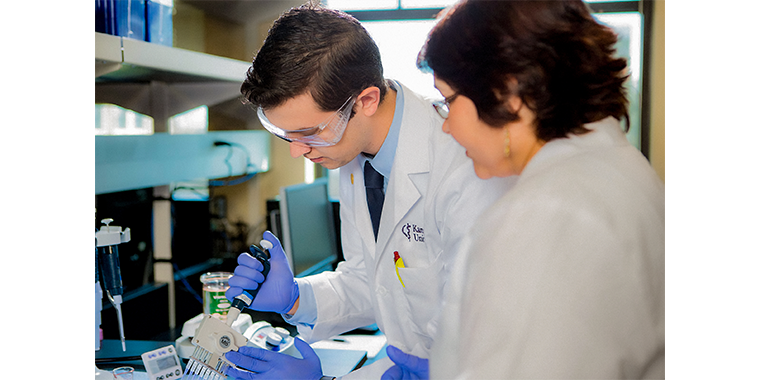
KCU provides students with more than just academic knowledge — it offers opportunities to engage in hands-on research alongside passionate faculty mentors like Asma Zaidi, PhD. As a professor of biochemistry and neuroscientist by training, Zaidi has built a lab environment where students explore scientific frontiers while receiving personalized guidance to grow as professionals and individuals.
Exploring the biochemistry of depression
At the center of Zaidi’s current research is an exploration of depression, a condition that affects millions worldwide. Traditionally, depression has been treated based on the serotonin hypothesis, which posits that low serotonin levels cause depressive symptoms. But Zaidi’s research takes a different approach, investigating how stress and inflammation can trigger depression at the molecular level.
Her work focuses on calcium regulation in the brain, specifically through a pump called PMCA (plasma membrane calcium ATPase). Calcium acts as more than just a mineral for bones — it plays a vital role in brain signaling. Zaidi’s lab studies how disruptions in PMCA activity can impair brain function, possibly contributing to depression.
“If calcium isn’t properly regulated, it can lead to neuronal dysfunction and even cell death,” she said.
Through these insights, Zaidi's research opens new possibilities for identifying novel treatment targets for depression beyond the traditional serotonin-based approach.
“We’re excited about the potential of our findings to lead to future treatments,” she said.
Students as research leaders
Zaidi’s lab offers more than cutting-edge science — it provides students with the chance to take ownership of their research journeys. Bryan Munoz and Thornton Mardis, both medical students at KCU, reflected on how transformative it was to work under her guidance.
“She gave us a lot of autonomy,” said Munoz. “We could come in whenever we wanted and do as much as we wanted. She encouraged us to explore what we were really interested in.”
Mardis echoed this sentiment. “It was a new area for all of us, even Dr. Zaidi. We started with literature reviews and learned about depression from a biochemical angle, focusing on PMCA, which is her expertise. She’s open to new ideas and really lets you drive the research.”
The two students also emphasized the personal side of their experience in Zaidi’s lab. “She kind of treats us like family,” Mardis shared. “We’ve had dinner at her place, and she really appreciates the work we do. There’s a lot of trust — you’re working with expensive materials, and every mistake costs money, but she supports us through the process.”
Mentorship beyond the lab
Zaidi’s approach to mentorship goes far beyond research techniques. “I love getting to know my students, not just as researchers but as people,” she said. “It’s about training them in professionalism — how to present their work, dress for presentations and communicate effectively. These are life skills that will serve them in any career.”
She challenges her students to develop confidence and resilience. “Not everything in research goes as planned, but I tell my students that failure is just a way for the experiment to guide you in a new direction,” she said. “It’s about having a growth mindset, learning to pivot and finding meaning even when results don’t meet expectations.”
A future of discovery and impact
Through KCU’s Summer Student Research Fellowship, students like Munoz and Mardis gain invaluable experience. Munoz spent eight weeks working full-time in Zaidi’s lab, gaining both research skills and insights into managing complex experiments.
“I’ve learned so much,” Munoz said. “Working in Dr. Zaidi’s lab gave me the chance to contribute to something meaningful, and I’ll carry those lessons with me throughout my career.”
For Zaidi, the research is only part of the reward. “It’s amazing to see my students grow from being unsure of themselves to becoming confident professionals,” she said. “It’s not just about the science — it’s about developing kindness, compassion and the ability to work well with others. Those values are essential in health care and life.”
Zaidi’s research at KCU is opening new doors to understanding depression while empowering students to take charge of their own growth. Whether in the lab or beyond, her impact is profound. As Mardis put it, “She’s not just a professor — she’s a mentor who gives us the tools to succeed and the freedom to discover what we’re truly capable of.”
Through her work, Zaidi exemplifies the spirit of discovery and mentorship that defines KCU, inspiring students to lead with curiosity, compassion and courage.
(0) Comments