


“It’s not just about the research.”
Unusual words coming from a research scientist—and they make sense when you talk to Ehab Sarsour, PhD, MSc., MS, associate professor of cellular and molecular biology/biochemistry at Kansas City University (KCU). The words make sense because he is passionate about translational research that moves discoveries in the lab to patient care with better patient outcomes, and he is passionate about his role as a mentor to students across all disciplines.
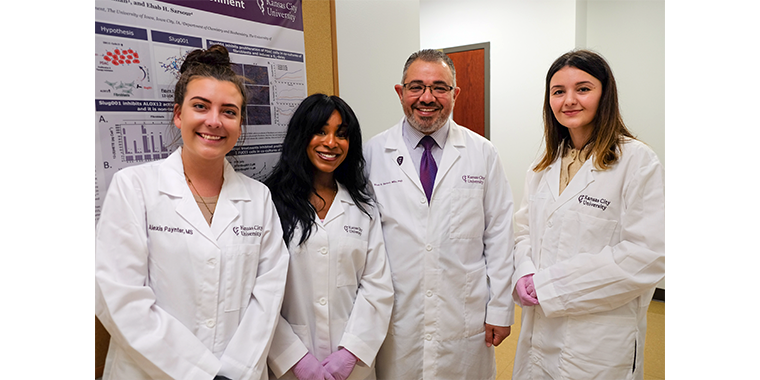
“KCU is very student-focused,” says Sarsour, whose research focuses on longevity and age-related disease, including cancer (one line of his work specifically aims to improve treatment outcomes for individuals with pancreatic cancer). Thanks to university funding and grants, he can actively mentor a handful of students who participate in this research. “My medical students have a competitive advantage when they apply for their residencies,” he says with pride.
Beyond doing good science and gaining recognition for KCU and students alike, he drives home the bridge to practicing good medicine that improves patients’ lives, he says. “Good research has to be significant. You have to be innovative; you have to be impactful.”
For Sarsour, mentoring students in his lab is far more than experiments. “This is not a ‘science project,’” he says. “I ask them, ‘What do you want from this?’” He trains student researchers to conceive an idea, plan experiments, analyze data, read scientific and medical literature, present their work at conferences and then publish. “It’s the whole experience,” he says.
KCU osteopathic medical students can pursue an elective research clerkship during their third or fourth year and compete for the Summer Student Research Fellowship (SSRF)—an intensive eight-week program where they conduct hands-on research alongside faculty mentors like Sarsour.
Second-year osteopathic medical student Ian Bosman has earned that coveted spot, joining the 2026 cohort.
Sarsour also leverages his personal network to connect students with opportunities at some of the nation’s most selective research programs. Through his research on aging, he has helped three students secure placements in the National Institute on Aging’s Medical Student Training in Aging Research (MSTAR) program—a highly competitive experience that pairs medical students with leading experts in the field.
“You know, we are getting published. We are getting awards—national and international,” he says. Findings from his lab appear in important peer-reviewed journals and show up in conferences and symposiums. Most recently, the cover of the January 2026 issue of Radiation Research featured his work, which involved KCU students and researchers at the University of California, the University of Iowa, the King Hussein Cancer Center in Jordan and Perspective Therapeutics, a radiopharmaceutical company in Iowa. It’s worth noting that while Sarsour’s lab generated the findings, the lead author was a KCU graduate and former SSRF student who worked there.
His primary research areas are head and neck cancer and the microenvironment of pancreatic cancer, where the end result is how physicians can enhance traditional radiation and chemotherapy. As Sarsour explains, “How can we make the cells more receptive to chemotherapy or radiation? What is preventing the radiation or chemo from having the desired effect?” That is a perfect example of translational research.
He emphasizes that “there is a lot of good research that will eventually be very, very, very important in the future. And it’s not necessarily something you will see now, but you'll see it in the long term. In the long term we will get there. Let's say, your sons, daughters, grandchildren will see it. It will impact their lives. Even if we don't know it now.”
So ultimately, Sarsour’s words make sense. Good research is about the research—but it’s not just about the research.


(0) Comments