


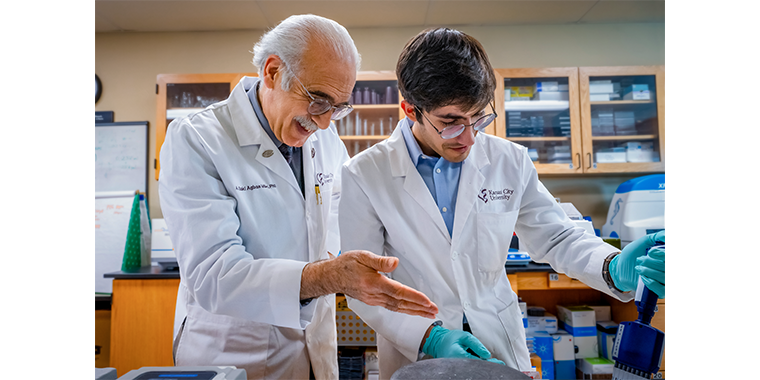
Mahan Hadjian didn’t expect to find himself at the cutting-edge of national research, but that’s exactly where he landed thanks to a prestigious fellowship at the National Institutes of Health (NIH). Hadjian recently spent a year at the National Institute of Neurological Disorders and Stroke at the Bethesda, Maryland, campus under the guidance of Richard Youle, PhD, who is well-known for his work elucidating the roles of mitochondria, mitophagy and autophagy in Parkinson’s disease.
“It was a great opportunity to expand my capabilities and learn,” Hadjian said. “Everybody was smart, curious and friendly.”
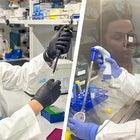
As he settled in at the NIH, Hadjian found mentors who challenged him to expand his knowledge and learn new techniques. Those mentors included Tara Fisher, PhD, who brought him onto a project investigating a protein called STING, a component of the viral-sensing pathway that can help explain immune response. “I come from a chemistry background, but not so much biology. So when I went in and they were telling me, ‘Okay, we’re going to culture HeLa cells (the “immortal” cells named for the patient Henrietta Lacks that have led to countless medical discoveries, vaccines and treatments since her death in 1951),’ — well, I didn’t have experience with that, and I had to learn how to culture cells, how to do any sort of DNA manipulation within cells utilizing a virus. How to take those cells and look at them under a sophisticated microscope.”
Hadjian describes the experience as intimidating at first, but at the same time exhilarating — especially for someone who has a keen interest in researching neurodegenerative disease.
“A lot of times when we’re discussing these diseases and diagnosing them, it’s a lot of just clinical diagnosis. The patient walks in and you say, ‘Okay, based off of how this person is talking to me right now, they seem like they may have dementia.’ But, you can’t go and confirm it until they die and you do a post-mortem biopsy. Being able to develop new diagnostic tests to catch these diseases early is something I am interested in working in.”
For Hadjian, the fight against brain-related disorders is personal. His grandmother’s long battle with dementia left an indelible mark on his family and inspired him to seek answers to brain-related disorders. “My grandmother had dementia, and it was very difficult to watch her progress over time. Waking up in the middle of the night not knowing where she was or always asking if we had eaten a meal. I have now seen a lot of patients suffering from dementia. Understanding the mechanisms of the disease and what sort of molecular players areall involved to create the disease manifestation will be key steps toward preventing or curing it.”
Hadjian’s fellowship came about due to the recommendation of Abdulbaki Agbas, PhD, KCU professor of Biosciences and friend of Dr. Youle. “Richard is a fellow mitochondria guy,” Agbas explained. “And Mahan is an outstanding student, both in research and in osteopathic medicine. I’m a PhD; I can see the mechanisms of how a system is working. But the people coming from the DO world coupled with the science, they will be able to identify the mechanisms then implement the clinical trials. This is what I see Mahan doing.”
Agbas believes the idea of nourishing and supporting budding physician-scientists like Hadjian will be key to solving some of the most complex disease processes in the world of medicine. He also sees Hadjian's work at the NIH as helpful when it comes to residency placement. “I believe he will be a top prospect,” Agbas said.
“As a DO, there is a big opportunity.” Hadjian said. “Having both the ability to do the research and then interact with patients in the osteopathic style of practice is something that is valuable. You are a unique ambassador standing at the interface of the science of disease and holistic patient care.
Hadjian further expanded on the importance of participating in research activities as an osteopathic physician. "It gives greater clarity of perspective when examining the patient. You can break them down to their molecular components to pinpoint what is likely wrong and which interventions will help, but as a DO, you are also trained to evaluate the patient holistically. We often espouse the virtue of not treating lab values, and I think DOs with a science background are especially adept at living up to this.”

Agbas and KCU research scientist Edina Kosa, who has spent countless hours supervising Hadjian in KCU’s lab, hope their protégé’s success will motivate other medical students to pursue the same path.
“I hope he will get the attention of others to let them know what is possible,” Kosa said. “Our lab here is a team. We welcome more students like Mahan. He is very smart; his comprehension is fast, and he is wise.”
Hadjian’s time at the NIH proved more impactful than he dreamed. Several months after returning for his third year of osteopathic medical school, he learned a paper he co-wrote was published in EMBO, a prestigious journal. The research delves into the STING protein research that first opened new horizons for Hadjian in the world of biology that will help pave the way for potential new treatments of infections and diseases.
“I would say, go in and put in the work, and if you put in the genuine interest, somebody is going to notice,” Hadjian recommended. “Never did I think I would end up at the NIH. But I came and worked in Dr. Agbas’ lab, where he was kind and considerate enough to help put together this opportunity. Great opportunities are out there.”

(0) Comments