


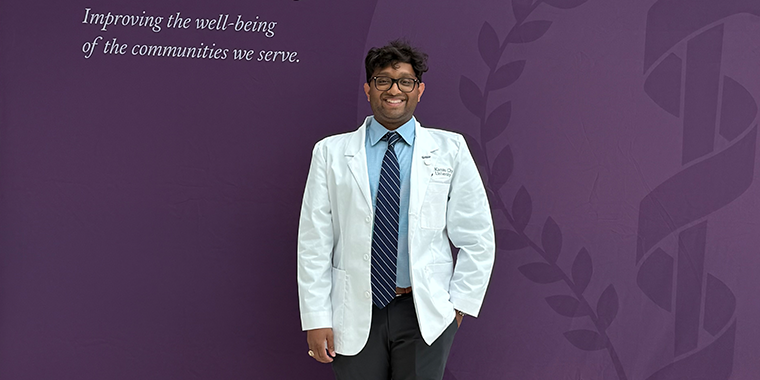
When Suhas Babu thinks about why he’s in medical school, he starts with his heart. Born with congenital heart disease he underwent open-heart surgeries in elementary school and again in high school. Growing up, he saw health care from two perspectives: as a patient in a large, academic medical center and through his father, a primary care physician caring for patients in rural and suburban Texas.
“I think that contrast made me pay attention to how systems support, or limit, care,” Babu said.
Long before medical school, Babu learned discipline in a very different setting. He spent years training in martial arts, eventually earning a third-degree black belt and serving as an apprentice instructor. The experience taught him focus and resilience—traits that continue to shape how he approaches school, leadership and service.
By the time he arrived at Kansas City University (KCU) as a first-year student in the College of Osteopathic Medicine, the Houston native had already earned a reputation for leadership and innovation in health care. As an undergraduate at Texas A&M University, he served in student government on the Student Health Services Advisory Committee. He later stepped into academic affairs roles supporting the College of Medicine, managed projects for a health-tech startup through the College of Nursing and completed a venture capital internship with BCM Ventures, the innovation arm of Baylor College of Medicine.
After earning a master’s degree from the University of North Texas Health Science Center at Fort Worth, Babu joined Baylor College of Medicine full time in business operations, becoming one of the youngest in administration there at the time.
While those roles offered a broader view of how health care systems operate, they also reinforced something else: he wanted to stay connected to the patients those systems were designed to serve.
As Babu prepared for medical school, the COVID-19 pandemic disrupted traditional pre-med pathways worldwide. While serving on the frontlines with the Harris County Medical Reserve Corps, he recognized how many students had lost access to shadowing and research opportunities. In response, he launched The Premed Scene in June 2020.
Although he wasn’t thinking about building an organization at the time, the nonprofit quickly took shape offering virtual shadowing, research competitions, podcasts, webinars, monthly newsletters and a global conference, ultimately reaching more than 3,000 students.
“Starting a nonprofit never entered my mind,” he said. “I just saw lots of pre-med students who didn’t have opportunities, and wanted to help.”
Today, Babu oversees an executive committee and intern team that keep the organization running while he balances coursework and extracurricular commitments.
His interest in using technology to solve practical problems soon extended beyond the nonprofit. His curiosity led him to AI for Health, a philanthropic program developed by Microsoft to support nonprofits, researchers and organizations addressing global health challenges. After reading an article on rural health and technology authored by a Microsoft executive, Babu reached out to learn more. That exchange led to mentorship, published work on the platform and projects exploring ways to use data to bridge gaps between rural and urban hospitals.
For Babu, technology is a means, not an end. Having spent years on the patient side of the system, he’s cautious of tools that promise efficiency at the expense of human connection. He believes artificial intelligence (AI) has a role in medicine—but only if it’s used thoughtfully.
His view is practical. There should be room for physicians who want to go deep with AI tools, alongside a baseline fluency that helps them do so safely and efficiently.
“AI will be part of everyone’s practice in some form,” he added. “But it should never replace the human in the room.”
Looking ahead, Babu hopes to build a career that reflects both his personal story and a professional purpose. He’s drawn to internal medicine, medicine-pediatrics and cardiology, and one day hopes to care for adults with congenital heart conditions like his own. He doesn’t see his future confined to the exam room, however. Whether he cares for patients, designs technology or devises business solutions to help them, his focus will remain on expanding access to care.
Wherever his next career leads, one thing is certain: he’ll put his heart into it.



(0) Comments