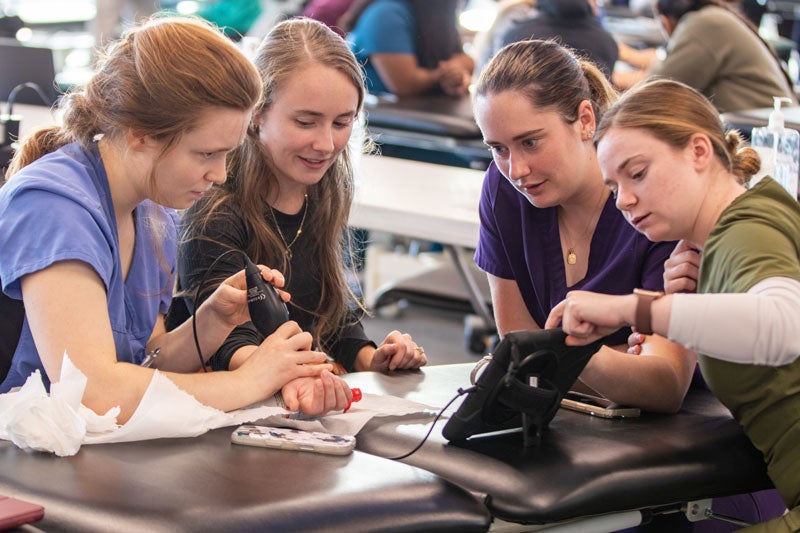
“Point-of-care ultrasound is the stethoscope of the 21st century. We want our students to graduate fluent in this technology, not just acquainted with it.”
- Dr. Robert Arnce, director of clinical integration
Before KCU student doctors step into a hospital or clinic, they first step into the immersive simulation environments.
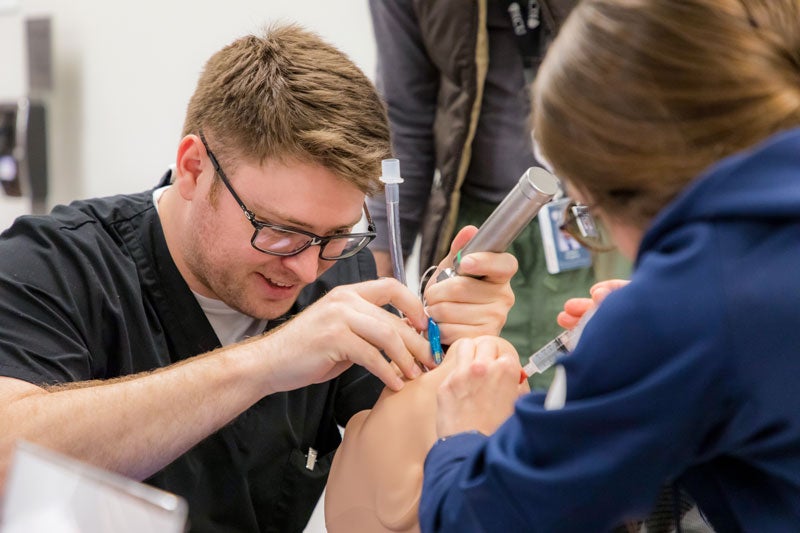
From day one, learners work through high-pressure scenarios that mirror the real world, assessing symptoms, communicating with patients, administering procedures and making team-based decisions. Every interaction is designed to build competence and confidence in a safe, high-tech space.
Our simulation labs feature everything from high-fidelity, responsive manikins that breathe, sweat and bleed to trained patient actors who provide real-time feedback on bedside manner. With faculty-guided debriefs, AI-powered ultrasound support and a curriculum that spans simulation across all four years, students graduate with clinical instincts already well-developed.
The KCU College of Osteopathic Medicine (COM) is committed to the pursuit of excellence in simulation, both in and out of the classroom. Through SIMPACT, KCU is advancing medical simulation education to create a learning environment that trains today’s students to transform the health of our communities.
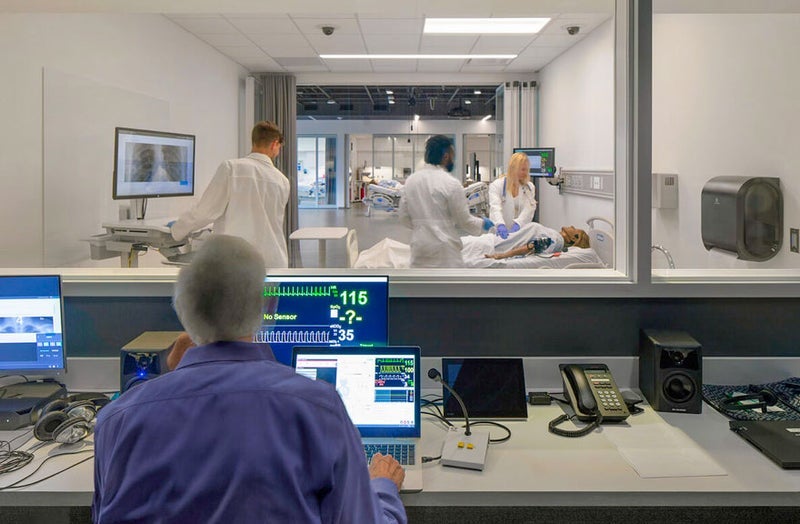
In KCU simulation centers students gain hands-on experience with life-like manikins, high-tech task trainers and simulated patients trained to portray real symptoms and emotions.
On the Kansas City campus, the Center for Medical Education Innovation (CMEI), provides four floors of flexible learning environments – including mock exam, ICU and L&D rooms for simulated patient encounters and manikin-based simulation scenarios – in one comprehensive facility.
Medical simulation activity on the Joplin campus is divided between the Freeman Health System Simulation Lab, a once functional ICU retaining much of its original clinical layout and the Empire District Electric Company Simulated Patient Lab, which mirrors an emergency department and preserves the footprint of its original hospital space.
Inside simulation labs, our students learn to start IVs, insert breathing tubes, check pulses, interpret heart monitors and respond to critical changes in patient status, often in team-based settings that reflect real emergency department workflows. With multi-angle video recording and live feedback, students can reflect on performance and continuously improve.
A separate Dental Simulation Lab serves students in the College of Dental Medicine at KCU-Joplin.
We integrates point-of-care ultrasound into the required curriculum for all medical students, making it a foundational skill from the start.
- Dr. Robert Arnce, director of clinical integration
In addition to POCUS technology, KCU medical students also utilize: