


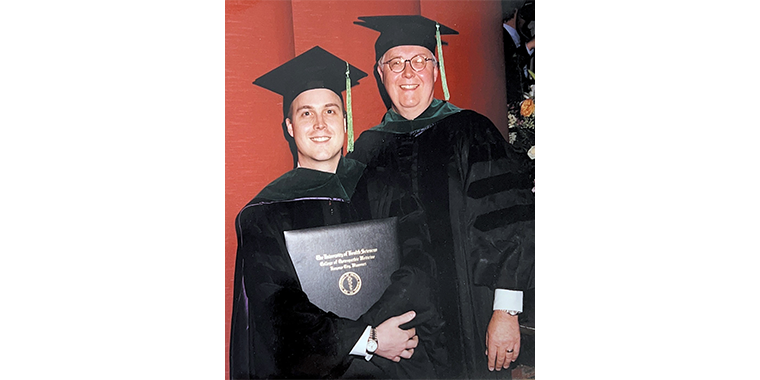
During his time at Kansas City University College of Osteopathic Medicine (KCU-COM), James Mackenzie, DO, began defining the kind of physician he wanted to become—one focused not just on clinical skill, but on understanding his patients. That perspective, however, took hold long before medical school and much closer to home.
Ask him where his career began, and he won’t mention medical school or residency. “My whole story starts with my dad,” he said. He grew up watching his father practice medicine in Rochester, Minnesota. Ronald MacKenzie, DO, graduated from KCU-COM in 1967, when it was still known as Kansas City College of Osteopathic Medicine. He went on to become the first osteopathic physician appointed to the Mayo Clinic staff. The elder Dr. MacKenzie set the example his son would later follow as a member of the KCU-COM Class of 2001.
Although he deeply admired his father’s career in anesthesiology, MacKenzie knew early that his journey would look different.
“I wanted to treat pain too,” he said. “But not the type my dad treated. I wanted to treat the pain people don’t talk about—the emotional pain.”
That realization led him to pursue psychiatry, and ultimately to Loyola University for residency. His early years as a physician coincided with one of the most defining moments in modern history: 9/11. An intern at the time, he witnessed firsthand how fear, insomnia and collective trauma drove people to seek emergency care.
One overnight shift changed everything, when three children came into the ER in quick succession with behavioral concerns. MacKenzie felt out of his depth. “I had no training in child psychiatry, and I was embarrassed,” he said. He called the child psychiatrist on duty at Ann & Robert H. Lurie Children’s Hospital for guidance, and that consultation ended up reshaping his career. The experience stayed with him and eventually led him to pursue a second residency, making him one of only about 50 child psychiatrists practicing in Chicago.
After years of hospital‑based work in emergency and child psychiatry, MacKenzie found himself thinking more about the circumstances surrounding the patients he treated. He spent more than a decade covering the emergency department at Lurie Children’s Hospital and working across the Northwestern Medicine network. During that time pediatricians and primary care physicians frequently called him for consults because they had nowhere else to turn. With so few child psychiatrists in Chicago, some families were waiting months for help. “They were doing everything they could,” he said of the physicians who reached out to him. “But the system wasn’t built to support them.”
Seeing that strain on families—and on the physicians trying to help them—brought to light gaps in the state’s mental health infrastructure that MacKenzie felt compelled to address. So he began working on efforts to improve access. He helped craft legislation that made Illinois the first state where Medicaid reimburses primary care physicians for collaborating with psychiatrists, allowing kids to stay with the doctors who know them best. He went on to serve as president of the Illinois Psychiatric Society.
MacKenzie’s advocacy work soon led to a gubernatorial appointment to the Illinois State Medical Board. Today, he serves as its chair. The role has given him a perspective on medicine that few physicians ever see. One of the most striking parts, he says, is understanding the human stories behind many of the cases that come before the board. “Physicians don’t set out to get themselves in trouble,” he said. “Often it’s exhaustion, burnout or a misunderstanding that snowballed.” He sees the board’s work as both protective and, at times, preventive—an opportunity to help physicians regain their footing rather than fall further behind.
Despite the weight of regulatory work, MacKenzie says the heart of his career has always been the kids and families he serves. He recalls one young patient he saw at a community mental health clinic on Chicago’s North Side. MacKenzie often walked a mile from the train to the clinic in winter, bundled against the cold. One day at Christmastime, the boy handed him a small gift. The family had very little, but the child had been saving coins to buy him a stocking cap because he thought the doctor looked cold on his walk to work. “It was the ugliest hat you’ve ever seen,” MacKenzie joked. “But I wore it every time I went to that clinic.” He still keeps the gift tag in his wallet as a reminder of why he chose this work.
As he reflects on his career, MacKenzie is quick to credit those who came before him, especially his father. “Everything I am and everything I have is because of the kind of dad I had. He, along with my mom, a special education teacher, made such an impact on people,” he said.
That impact, he adds, is what he hopes to pass along to the patients he cares for and the students he mentors. And in that, he hopes to honor the example his parents set for him.

(0) Comments