


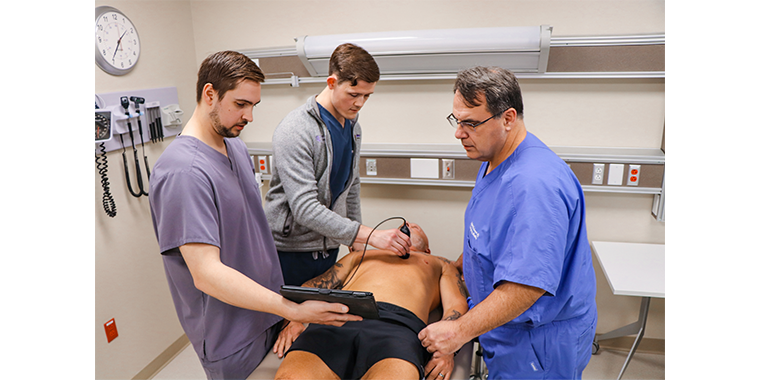
KCU students are among the first to wield new AI-powered POCUS devices – training with tech that feels like portable, medical magic.
KCU ushered in a new era of medical education with a pioneering point-of-care ultrasound (POCUS) elective launched in fall 2024. Developed in collaboration with Butterfly Network, Inc., this forward-thinking course equips future physicians with essential ultrasound skills earlier than ever. For KCU students, it means entering residency ready to make faster, more informed clinical decisions.
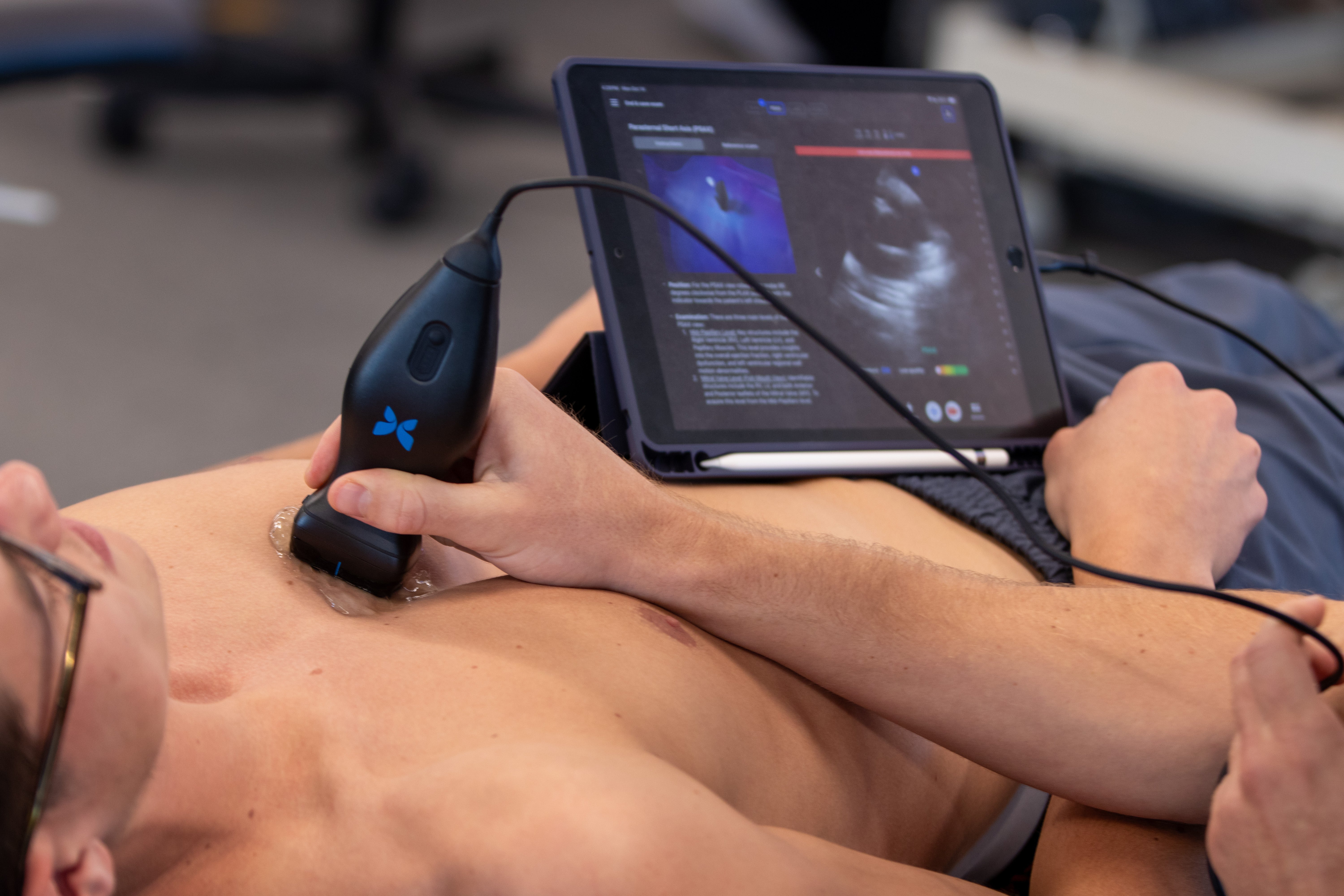
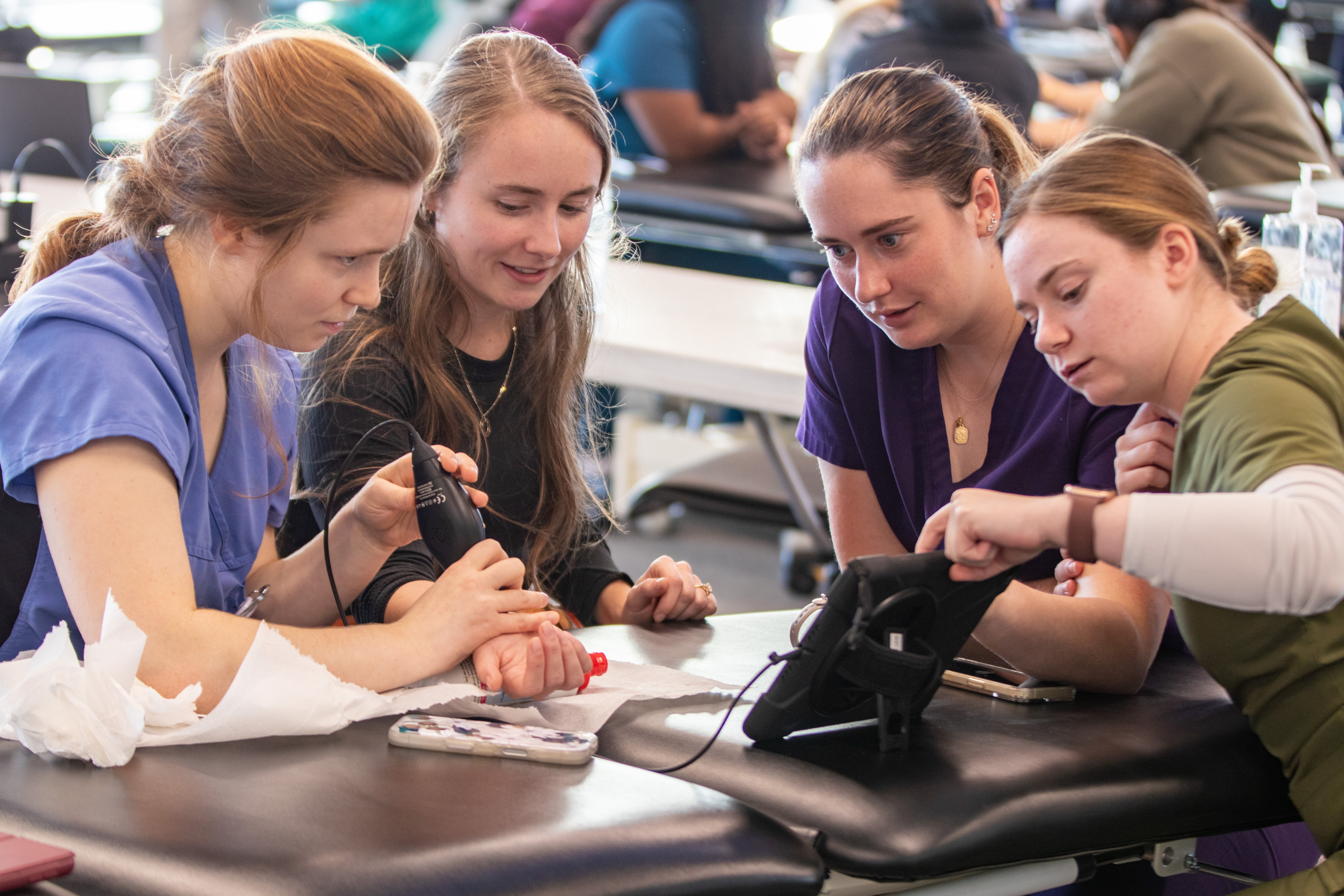
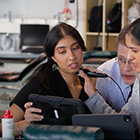
The ultrasound elective combines AI-powered tools with hands-on practice, allowing students to master essential scans, including heart, lung, and eFAST (Extended Focused Assessment with Sonography in Trauma). The system guides students with step-by-step instructions, labels anatomical structures and provides feedback on probe placement by comparing their scans to reference images in real time. With the AI-driven Butterfly ScanLab platform, students learn to capture and interpret ultrasound images while receiving instant feedback, which helps them self-correct and refine their skills independently.
Nearly 300 students enrolled in KCU’s POCUS elective for the 2024-25 academic year, completing related courses in Butterfly Academy to build skills and earn certifications at their own pace.
Fourth-year medical student Chance Benedict says this approach has transformed his training, blending theory with hands-on application. “It allows us to learn on our own,” he explained. “You’re not just reading a book or watching videos. You’re actively scanning, getting feedback and improving your technique instantly.”
While POCUS is becoming indispensable in health care, most medical schools still lack structured training in this area, leaving many physicians to learn these skills during postgraduate training. By addressing this gap, KCU arms students with a critical advantage as they enter residency programs.
“Residency comes with a steep learning curve,” notes Robert Arnce, MD, KCU’s director of clinical integration. “POCUS is the stethoscope of the 21st century, changing the way we assess, diagnose and treat patients. When our students enter with POCUS proficiency, it not only eases the transition into residency, it sets them apart from their peers.”
The Butterfly ultrasound probe’s portability and versatility also make it indispensable in resource-limited settings, such as rural hospitals or disaster zones. Unlike traditional ultrasound machines, this compact and affordable device produces high-quality images in challenging environments. KCU’s training empowers students to bring diagnostic excellence to any specialty or location, including smaller clinics or hospitals where traditional ultrasound access may be limited.
Patients benefit enormously from this noninvasive technology. Because POCUS can be performed at the bedside, it often replaces more complex, costly and anxiety-inducing procedures, such as CT scans. This approach is especially beneficial for patients with mobility issues or those prone to claustrophobia, for whom traditional imaging techniques can be uncomfortable or distressing.
Patrick Riscoe, DO, a 2025 graduate of KCU-COM saw firsthand how his POCUS training directly improves patient care, using it almost daily in his emergency medicine rotation. “It’s extremely noninvasive,” Riscoe explains. “A CT scanner can be overwhelming, especially for patients who are claustrophobic or in significant pain. With POCUS, we can perform a scan in a comfortable setting, and the patient doesn’t even need to be transported or repositioned, which can ease their discomfort. Whether it’s assessing abdominal distress, evaluating a lung condition or helping with IV placements for patients with difficult veins, POCUS makes the process more comfortable and less invasive.”
POCUS training isn’t just an elective — it’s a bridge to better patient care, whether in a rural clinic or a busy emergency room. With this innovative course, KCU is shaping the future of medical education — one scan at a time.

(0) Comments